Yana Yana sho
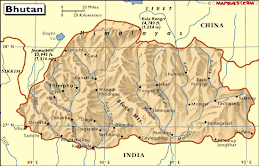
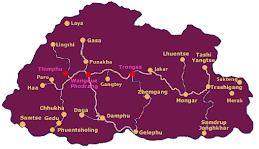
‘Yana Yana sho (come)’ is becoming a familiar call within the Tara-thon team. It is a call to our new Tara-thon four legged runner Yana. On the second day of our run Yana decided to join us and has been with us ever since; eating, sleeping and of course running with us all the way to Mongar. As for us, we’ve done six days of running down from Kanglung to the river, up over our first mountain pass, Kori La (2400m), and down again to Mongar.
Despite the aches and pains, morale is high. Every one is still on board and keen to undertake the second week of running. This will be our most challenging one as we will be climbing up to Thrumshing La (3750m) before heading down to Bumthang.
Our dog, Yana, and your generous contributions are a source of inspiration that hopefully will carry us all the way to Thimphu. Thank you from the Tara-thon team.
Nadya
Below are entries from Tony and some of our runners.
Enjoy.
***
Day 1: ThruselWe stand in a neat row at the college gate, caps off, heads bowed, facing Lam Neten of Trashigang dzong (abbot of the local monastic fort) and Khenpo of Kanglung shedra (head of the monastic school beside Sherubtse). They perform a Buddhist blessing called ‘thrusel’. The two men are shaven-headed, dressed in red robes and chant strings of strange words into the sky just over our heads. A teenage monk passes in front of us with a mirror and a bumpo (bronze jug like a long-necked teapot with a peacock feather sticking out the top) of holy water. He pours a thin, wobbly line at our feet, then another and another. It seems he is drawing a diagram of the mountains we will cross. Next, Lam Neten takes a handful of rice from a bowl and scatters it over us, as a farmer might sow seed. He does this with his right hand while sounding a little wooden drum with string clappers with his left. Back home, someone would fire a pistol to begin a marathon.
“Thrichu, holy water, is offering to good spirits for success of our mission,” explains Mr Rongthong Sangay later. “Mirror send our prayers back to us. Rice purify our bad deeds.”
“And what do the words mean?”
“All beings should support as a whole, universal.” I look at Mr Sangay puzzled. “If good luck come to Mr Tony, then this good luck will go from him to other beings. If good spirit good to us, we in turn good to other.” It was Mr Sangay who said we must have thrusel before beginning our Tara-thon.
The blessing ends with Lam Neten tying a small pouch of prayers on a bit of string round our necks. The Khenpo follows placing a kada (white silk scarf given to a person arriving or departing) over each runner’s head. For further good luck, we walk around Kanglung shedra three times, spinning flask-size hand prayer wheels set in the wall as we go.
Tony Robinson-Smith
Project Leader
Project Leader
***
Day 3: Royal Heart and Foot Inspection
“I hope their hearts are strong for this.”
“Oh yes, Your Highness. Our runners are thoroughly committed to raising money for Tarayana, dedicated to helping disadvantaged children go to school.”
His Royal Highness Prince Jigyel Ugyen Wangchuck looks at me unsatisfied. Behind him is a large black land cruiser license-plated ‘BHUTAN 17’. A burly bodyguard in matching black gho with a crew-cut stares at the row of sweaty students in Tara-thon t-shirts standing to attention at the side of the road. We are half-way through our third day of running, tracking the curves of the green Mithidang river.
“No, I mean, physically. Are their hearts ok?”
“They had to pass a three-day running test before we accepted them on the team,” offers Nadya helpfully. “And they did two months of hard training.”
The Prince looks down at the shoes belonging to the student standing next to me, Tshering Dorji. He is probably the quietest member of the team.
“Those shoes are too big. And in a rotten state.” The Prince reaches down and presses the toe. Tshering is wearing black baseball pumps, the type that laces up around the ankle and has practically no tread. A kind of white skin covering the toecaps is flaking off. Due to the absence of toes, the toecaps have turned up, making Tshering look rather like a poor court jester.
I sigh. As project leader, perhaps I am partly to blame for this. Our student runners were all given kit lists long before the event, recommending two pairs of new running shoes. I assumed they would simply comply. I picture Tshering Dorji stumbling bloody-toed into Thimphu, King frowning. Tshering mutters something to the effect, “I feel comfortable in these, Your Highness.” The Prince moves down the row, inspecting footwear and evidence of hard training.
“What size are you?” whispers the bodyguard to Tshering.
“Th-thirty-seven, Sar,” he replies sheepishly.
The Prince wishes us all tashi delek, good luck. BHUTAN 17 plus army escort heads off for Mongar. We’ll be there on Wednesday. Shoes permitting. Maybe there’ll be a package waiting for the quietest Tara-thonner.
“Now that His Highness has touched these shoes, I’ll never throw them away,” says Tshering. We laugh and continue our run.
Tony Robinson-Smith
Project Leader
Project Leader
***
The Journey Through…
Looking towards the western horizon, the sun his hidden behind the hills casting darkness all over and bringing along the cold winter breeze. It was the end of our fifth day of running and we were on the top of the first pass of our expedition – Kori La (2400m). Everyone seemed tired after the 19kms of uphill climb from Yadi. The clock on my cell showed that it was 6:30 p.m. and by then we had finished eating our dinner. Defending ourselves from the cold we were wrapped in warm clothes. Sitting inside the camp I reflected over the past four days. It seemed as if the days had just whistled by and we had covered 96 kms. Yet, making up to Kori La was not an easy task. Even though vigorous training before the run had physically prepared us, the downhill run was one of the challenges. Running down meant stress on our knees though it did not tire us.
The real challenge came after our first three days of downhill run. It was an uphill climb till Yadi and then to Kori La. From Sheritchu we bid farewell to the easy days of our expedition. The lack of a proper camping site in Sherichu drove us further up (7kms) in pursuit of a suitable place. So, we covered a few kilometers of the next day’s run.
The fourth day was quite relaxing; it was 12 kms of uphill climb to Yadi. In Yadi, we were fortunate that we got to witness the Ngatshang tshechu and it was an opportunity for us to hunt for some donors.
It’s true that when the going gets tough, the tough get going and finally through all the hardships we were on top of the hill. Being superstitious enough, the blessing from his holiness the Lam Neten and the Khenpo of Kanglung Shedra and all the well wishers brought us till here and I hope it will drive us further to our destination.
Every step we take will be a step towards our dream and a ‘service from the heart’.
Personally, the encouragement from our coordinator, team leaders and the excitement on the faces of my team mates will keep me going. Every moment of the run will remain in my heart as cherished memories from times to come.
Looking towards the western horizon, the sun his hidden behind the hills casting darkness all over and bringing along the cold winter breeze. It was the end of our fifth day of running and we were on the top of the first pass of our expedition – Kori La (2400m). Everyone seemed tired after the 19kms of uphill climb from Yadi. The clock on my cell showed that it was 6:30 p.m. and by then we had finished eating our dinner. Defending ourselves from the cold we were wrapped in warm clothes. Sitting inside the camp I reflected over the past four days. It seemed as if the days had just whistled by and we had covered 96 kms. Yet, making up to Kori La was not an easy task. Even though vigorous training before the run had physically prepared us, the downhill run was one of the challenges. Running down meant stress on our knees though it did not tire us.
The real challenge came after our first three days of downhill run. It was an uphill climb till Yadi and then to Kori La. From Sheritchu we bid farewell to the easy days of our expedition. The lack of a proper camping site in Sherichu drove us further up (7kms) in pursuit of a suitable place. So, we covered a few kilometers of the next day’s run.
The fourth day was quite relaxing; it was 12 kms of uphill climb to Yadi. In Yadi, we were fortunate that we got to witness the Ngatshang tshechu and it was an opportunity for us to hunt for some donors.
It’s true that when the going gets tough, the tough get going and finally through all the hardships we were on top of the hill. Being superstitious enough, the blessing from his holiness the Lam Neten and the Khenpo of Kanglung Shedra and all the well wishers brought us till here and I hope it will drive us further to our destination.
Every step we take will be a step towards our dream and a ‘service from the heart’.
Personally, the encouragement from our coordinator, team leaders and the excitement on the faces of my team mates will keep me going. Every moment of the run will remain in my heart as cherished memories from times to come.
Sonam Wangdi
B.A. (Hons) English II year
B.A. (Hons) English II year
***
Running for the kids
I am on the top of our first pass, Kori La, and almost a week is completed. I am proud that the hardest part of the journey, which has to do with adaptation to sudden changes, is now over. When the passers-by smile at us, I am encouraged. KIDS are all that I have in my mind and when pain registers in my brain, I roll up my shirt and see ‘Run for the kids’. It instills in me inspiration when I lack vigor. It keeps me going even through exhaustion. At the end of the day when many donations come in then the pain that I go through is justified. Every single ngultrum makes a difference. Please donate.
Ugyen Lhendup
B.A. Hons (Economics III)
B.A. Hons (Economics III)
***
The road to success
‘Tara-thon’ is a word that combines ‘Tarayana’ and ‘Marathon’. To make our Tara-thon a success, we have 12 runners including two English lecturers, Mr. Tony and Madam Nadya with our coach the Director of Sports for Sherubtse College, Mr. Rongthong Sangay. We also have Mr. Ngawang who is a very important member of our party because he prepares our meals. We also have Mr. Kezang who is our bus driver. Let us not forget to mention Yana. Yana is the name given to the dog with us. This male dog has followed us from Trashigang. It seems he has strong determination and believes in our Tara-thon. Like wise, we are very fortunate to have lost of people along the way smiling at us seeing our white shirts with the word ‘Tara-thon’ written on them. We are grateful to them for supporting our Tara-thon with hearts and little contributions. At present, we are at Kori La which means we have covered 84 km in four days starting from the college gate at Kanglung. Every one of us is happy because nobody has got injured so far. Therefore we all pray for the same luck till the end of our project. Our run from east to west is 600 km. This project is to raise funds to contribute to the Tarayana Scholarship Endowment Fund. We hope this project will make a big difference – especially for kids from poor families to go to school.
Sonam Gyelpo
B.Sc. Life Science I year
B.Sc. Life Science I year
***
Why I am running
I neither want to gain name or fame, nor am I a passionate athlete. I am running not only for myself but for a worthy cause – a simple cause that can change the destiny of others. When we see a child working in construction, road, hotels, etc. we feel pity. Pity is not enough; they need to have something more in their lives. I would like to request each and every citizen of Bhutan to donate a few ngultrums so that these kids can go to school just as your children can. Please set an example that can never be forgotten in your life by donating a few ngultrums.
Yenten Jamtsho
B.A. English-Geography I year
B.A. English-Geography I year